

Amazon looks beyond the GTIN. The market is looking for trust
In recent months, Amazon has been stepping up its verification of products, companies and product data. The focus is no longer solely on identifying products, but also on who is behind a GTIN, which company is responsible and how a product or brand is linked to it.
The collaboration between Amazon and GS1 reflects a broader evolution: from product identification to a trusted digital product identity.
Improved GTIN verification
This evolution has not come out of nowhere. As the world’s largest online marketplace, Amazon handles millions of products from hundreds of thousands of sellers. This brings challenges such as incorrect product information, duplicate product listings, misuse of identifiers and claims that are difficult to verify.
Today, Amazon still receives data on licence holders separately from participating GS1 organisations. This means that the available information and the way it is provided are spread across different data flows, making verification less efficient.
Amazon and GS1 are therefore working on a new approach that will make licence and company data from the wider GS1 federation available in a more centralised way. This will give Amazon access to a broader set of GS1 data and allow it to apply its verification processes more consistently.
From GTIN to company and brand
But Amazon is looking beyond simply checking whether a GTIN is linked to a valid GS1 licence.
An important next challenge is the relationship between the brand, legal entity and GS1 prefix. Today, establishing this link still partly requires manual follow-up. Amazon and GS1 are therefore exploring how this verification process can be further automated.
This raises questions such as: which company is behind a brand? What happens to existing GTINs when a company is acquired? What is the relationship between a reseller and a brand owner? And how can changes to legal entities be handled correctly?
Amazon wants to better understand what data GS1 has available in this area and how information about companies, brands and ownership could contribute to verification in the future.
This evolution goes beyond Amazon
The importance of reliable product information is also growing beyond online marketplaces.
The rise of AI is reinforcing this need. AI systems depend on available and interpretable product information to find, compare and recommend products. The more accurate and better structured this information is, the more reliably it can be processed.
New regulations are also contributing to this evolution. The Digital Product Passport is one example. For certain product groups, companies will be required to make information digitally available on aspects such as materials, performance, maintenance and sustainability.
The specific applications may differ, but the underlying need is the same: reliable information must be digitally linked to the right product and be usable by different parties.

The GTIN is not becoming less important
Amazon’s evolution does not mean that the GTIN is becoming less important. Quite the opposite.
The GTIN provides the foundation on which an increasing amount of information can be linked and verified. Identifying the product is the starting point. The next step is to reliably connect the parties, brands, data, claims and certifications associated with that product.
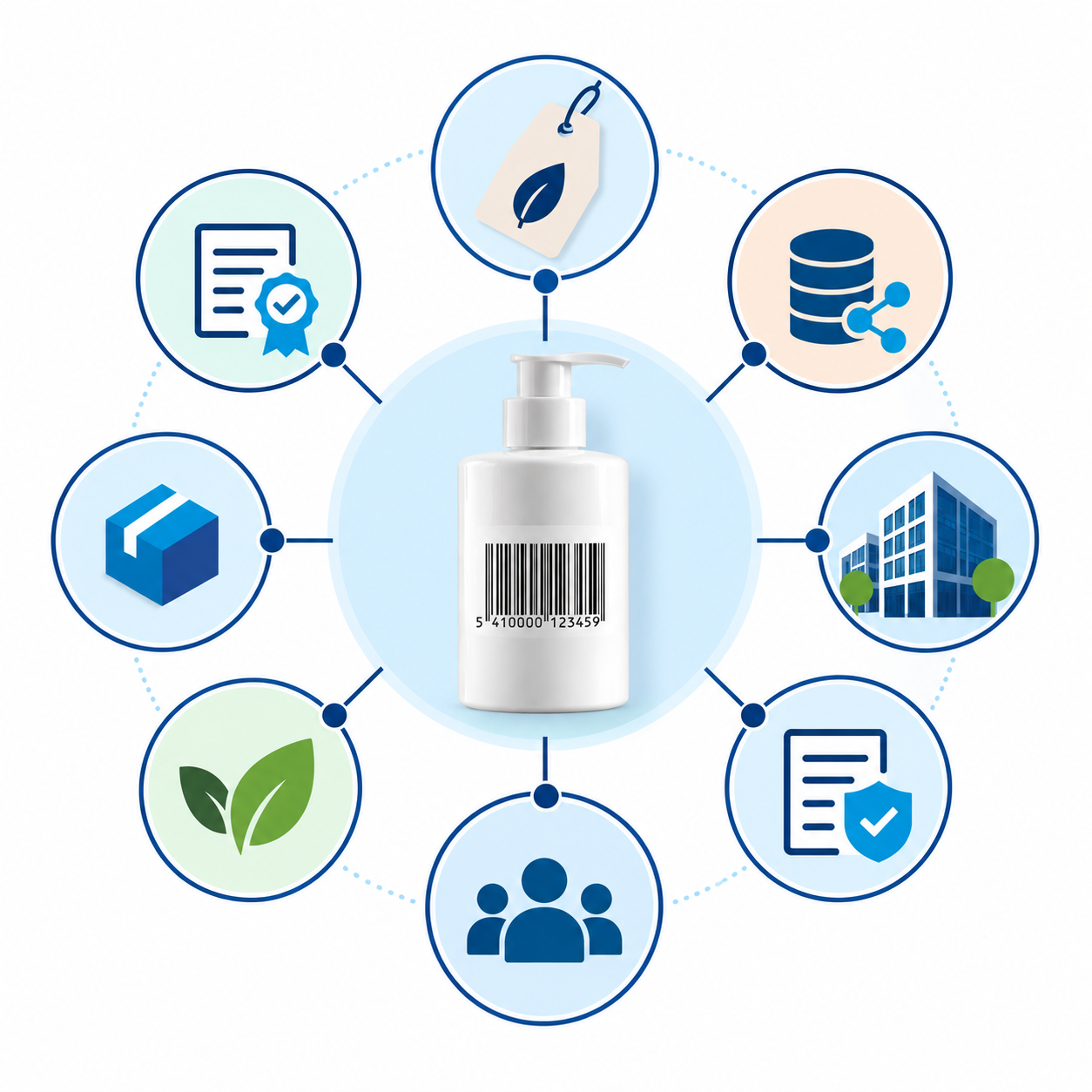
Recent developments at Amazon make this shift very tangible. In the digital economy, it is increasingly no longer enough to know which product you are looking at. You also want to be able to trust who is behind it and what is being said about it.