New battery rules?
Here’s how to share product information efficiently using the QR code by GS1 and GS1 Digital Link.
From 18 February 2027, new requirements under the EU Battery Regulation (EU 2023/1542) will apply to consumer batteries and small portable rechargeable batteries.
Manufacturers, importers and suppliers will be required to make certain product information digitally available via a QR code.
Below, you can find out:
- which batteries are subject to the new requirement;
- which information must be made digitally available;
- and how the QR Code by GS1 and GS1 Digital Link can help you prepare a future-proof solution today.
For many organisations, it is still unclear which information will become mandatory and how it can be made available efficiently and in a future-proof way. With the QR Code by GS1 and GS1 Digital Link, GS1 helps companies make this information available in a structured and consistent way.
Which batteries does this apply to?
The requirements apply to the following product categories, among others:
- consumer batteries such as AA, AAA, C, D, 9 V and button cells;
- small portable rechargeable batteries weighing up to 5 kg, for example those used in electric toothbrushes, drills, shavers and toys;
- other battery categories, such as EV batteries, LMT batteries and industrial batteries. These are also covered by the regulation, but additional requirements apply.
Which information must be made digitally available?
- Battery type and specifications
- Presence of hazardous substances such as cadmium, lead and mercury (in force since 18 February 2024)
- CE marking (in force since 18 February 2024)
- EU Declaration of Conformity (already in force since 18 February 2024)
- Performance information, such as reasonably expected service life, capacity and rechargeability (already in force since 18 August 2026)
- Collection information, such as the crossed-out wheeled bin symbol, how and where to return waste batteries, and the correct method of disposal (partly in force since 18 August 2025)
Why use the QR code by GS1?
Prepare your packaging for the future today with the QR code by GS1.
By including the GTIN in the QR code, you clearly link the mandatory information to the correct product and avoid duplicate work when new digital information requirements come into force.
Until the end of 2027, both the QR code and the traditional barcode will still need to appear on the packaging. This allows retailers to continue scanning the traditional barcode. After that, you can choose to keep only the QR code.
How to integrate?
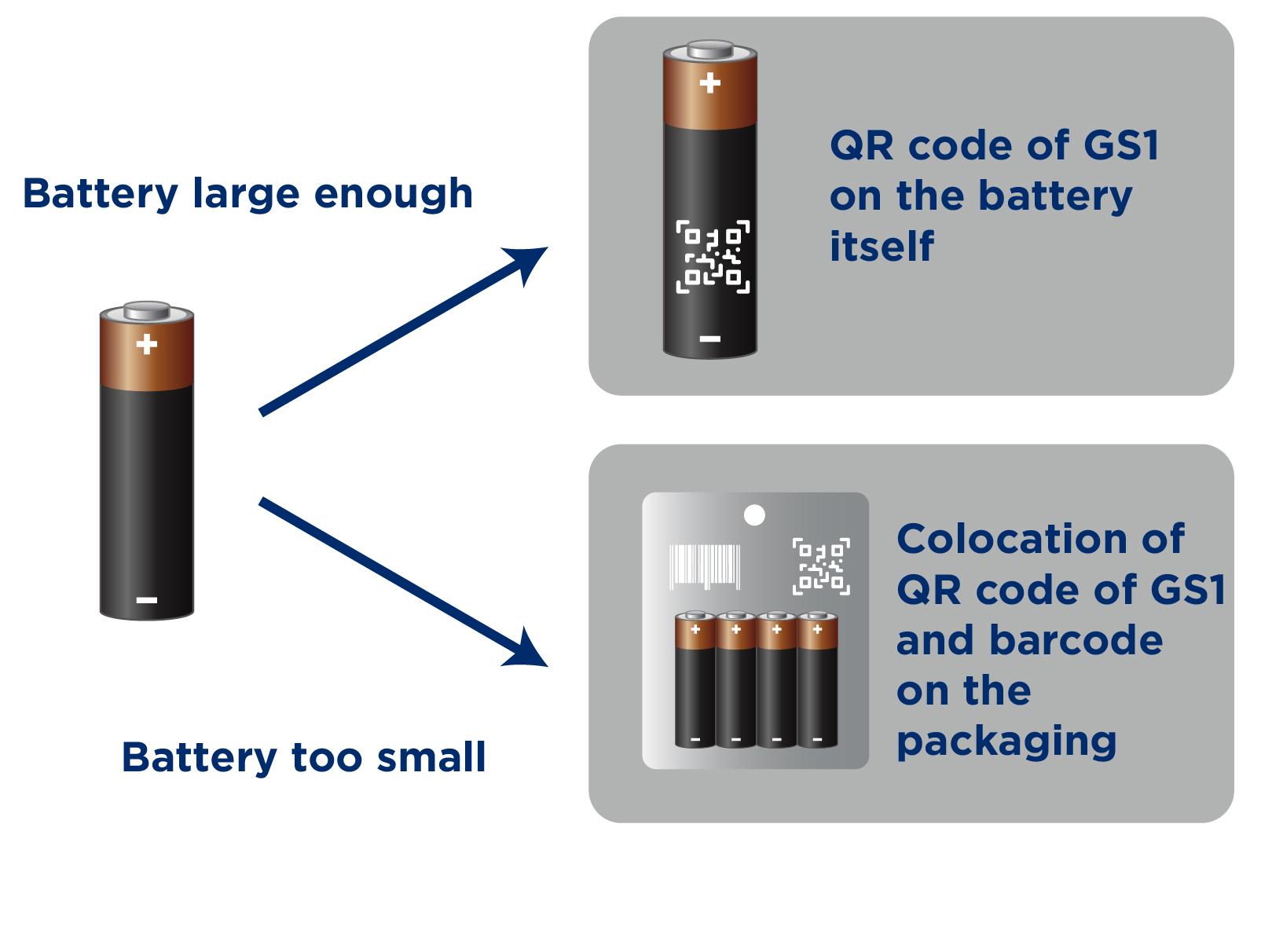
When selling a product (such as a torch) with batteries included in the packaging (sales unit), the QR code must appear on the battery itself. If this is not possible, the battery’s QR code must appear on the packaging or in the instructions.
Depending on the size of the battery, you may therefore be able to place the QR Code by GS1 directly on the battery.